Upcycled

Worn out and patched jeans

At the end

I try to purchase most of my clothing at thrift stores and spend way too much time looking for just the right piece. Function and appeal are top decision makers, but there are a few brands that I love. My Carhartt jeans are one of my favorites. I wore and patched my first pair until they were so thin that I would need to line them with patches to continue wearing them. The next step was to take them to my friend Jerry who makes custom rag rugs. He had questions for me…should the jeans be matched with cool or warm colors? what size of rug would I like? I’ve seen enough of Jerry’s rugs to know that he would come up with something wonderful. He did!

Jerry holding rug he made from jeans

Jerry and the jeans rug

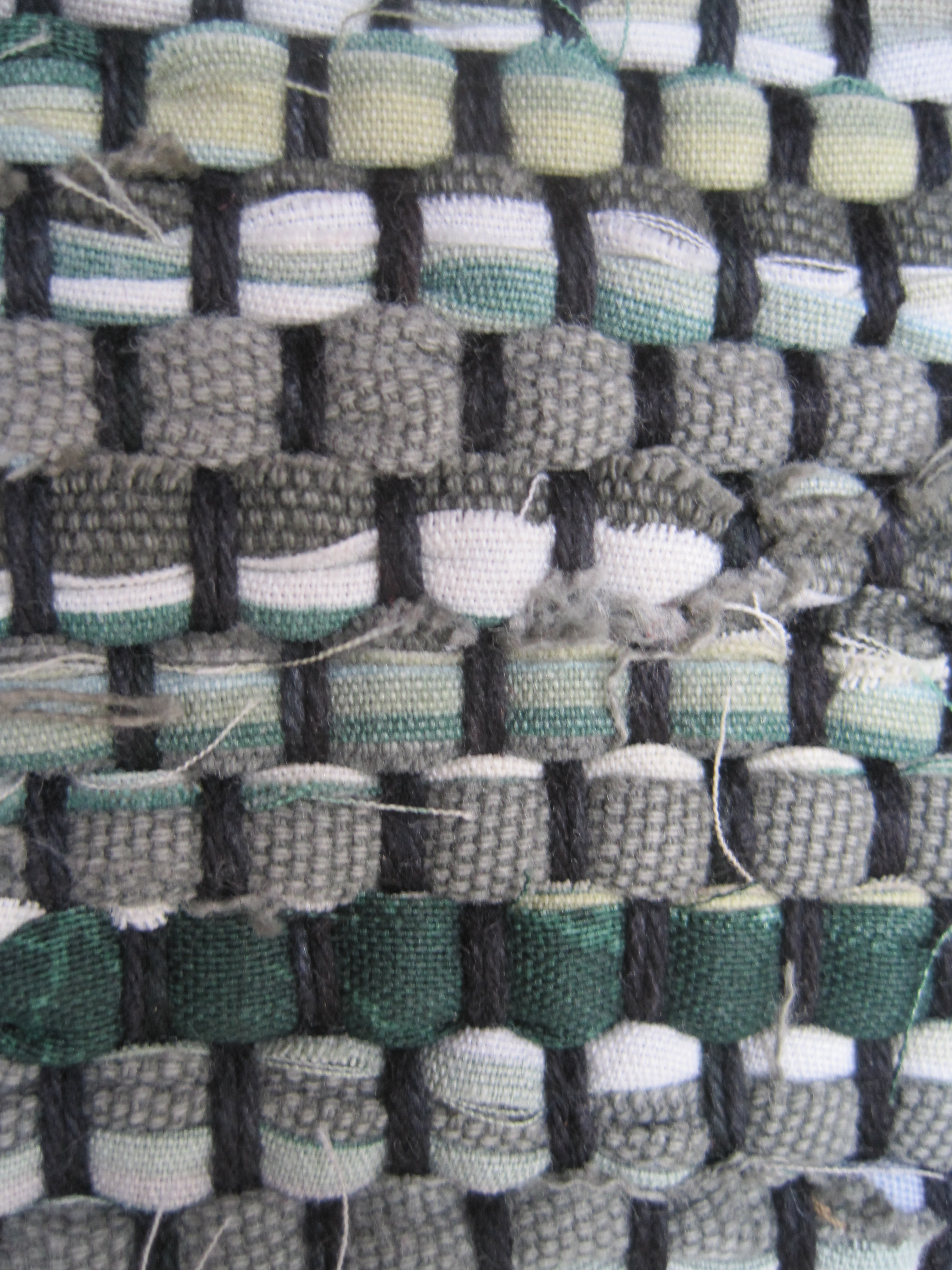
The jeans were woven with an old gray work shirt and striped green sheet. Jerry even un-patched the jeans and used the belt loops to make the rug, which is way beyond the  work I expected him to do! Jerry asked me where I planned to use my rug. I don’t know…I just loved my jeans so much that I didn’t want to get rid of them!
It's all in the detail

A few other things that deserve mention:

Robbie, Charlie, and I went to our first donkey basketball game featuring students, teachers, and firefighters. Charlie couldn’t miss the opportunity for a silly smile.

Close-up photo of Charlie with a silly expression

Charlie smiles

How to spell that word that describes something that is marked with or having stripes? Is it striped or stripped? I use the Google “define” tool often when writing. To use it, go to a Google search box and type define: word followed by the enter key. You will get a definition followed by links to associated websites.

Yoga class is held on Wednesdays and I almost always look forward to it. During the cool months class is held in a building that once was an Odd Fellows hall. Steep and narrow stairs lead from Main Street onto the second floor of the building. The room has wood floors, a high ceiling covered with stamped steel sheets, and marquee lights around the edge of the ceiling. It was hard for me to photograph. It is a wonderful space, despite the peeling paint, dead light bulbs, and after-market wiring.

Lights on ceiling in yoga room

Ambiance

Book hangover material: Marcelo in the Real World. The New York Times review of it in LibraryThing is a good one. If you read The Curious Incident of the Dog in the Night-time and enjoyed it, you will probably like Marcelo. Both books are coming of age stories narrated by a character with high functioning autism.

Over Thanksgiving weekend, my cousin Jessie was a good sport and let me decorate her pregnant belly with henna. She’s a great sport because I’m slow and not-so-artful. We talked about a professional henna stylist who decorated my arms in India and how fast she was. Here’s a video clip of it that I uploaded to YouTube.

Fall to winter

Tuesday

I’m thankful for our public servants and those who keep an eye on them. I attended the county board of supervisors public hearing for the 2012 budget in the morning and the public library board meeting in the evening. It is a challenge to match revenue to services, however we can meet this goal if we work together.

Wednesday

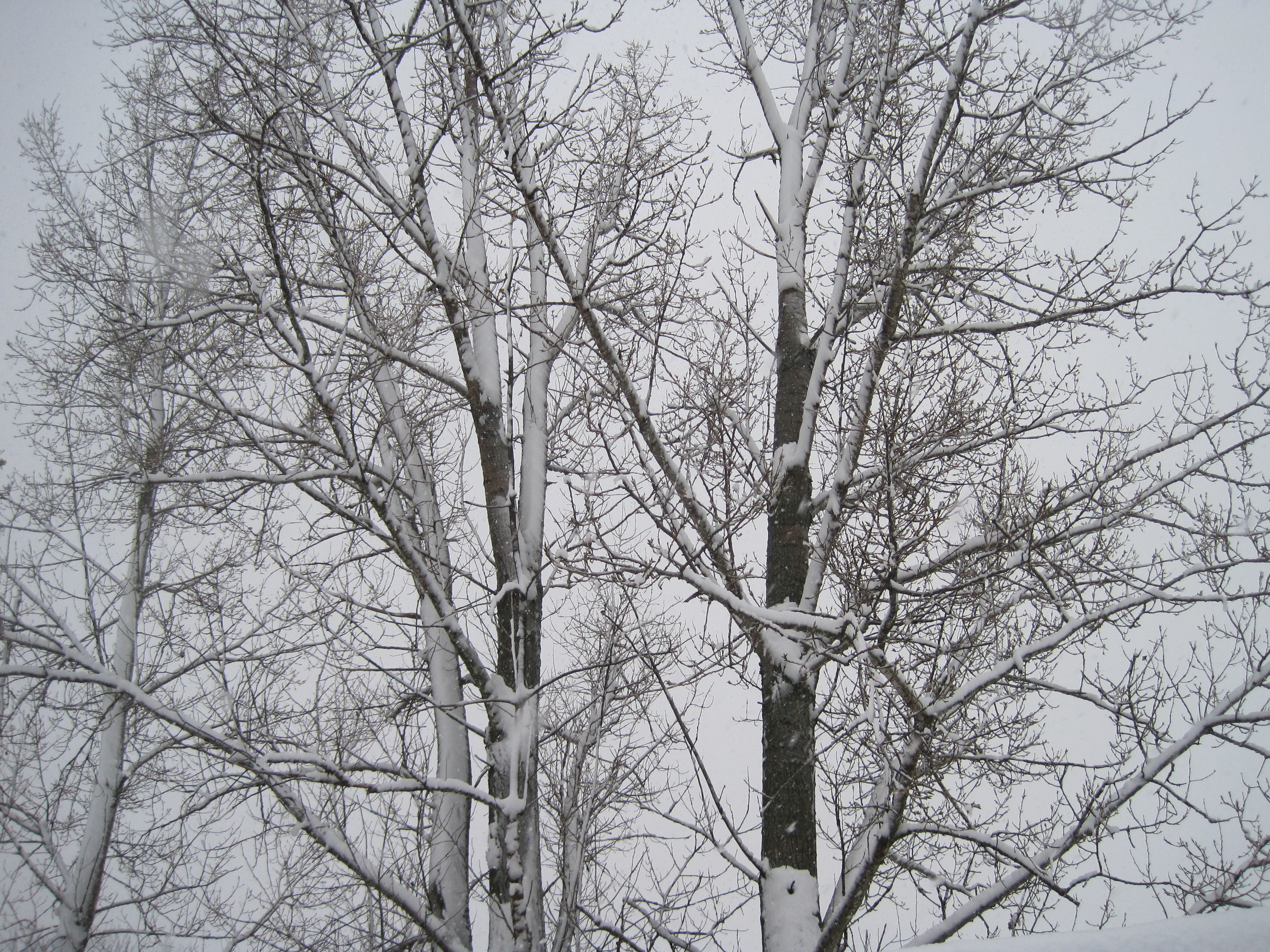
It sounds like guns firing at varied distances from our house, but it isn’t good hunting weather out. Heavy, wet, white snow is falling everywhere. I suspect the globs of snow falling from the cottonwood trees onto our poorly insulated roof are making the gunfire noise. I went out to photograph our first snow and was treated to the loudest thunderboom that I’ve ever heard in the snow.

The first snow

Quince tree bowed in the snow

Cottonwood trees in the snow

My culture shows because I’m more concerned about my roof caving in because of  heavy, wet snow than militant hunters who will apparently hunt in  any weather. For the first time in my life, I shoveled a roof (at least part of it). I was well soaked by the time I got back into the house.

While the snowing continued, the sheep went out to eat in the front yard (the mobile electric fence either shorted out or simply tipped over). By the time I got back to photograph the evidence, the snow had already blotted out the muddy hoof prints.

What was recently yummy kale

I’m thankful to have  a short, fat, old glassblower for a friend and to see him quoted on Science Friday!

Photo of wet newspaper

Transparency in the media

I should have picked up my paper before it got soaked.

Growing dirt

It was a beautiful November day today, perfect for growing dirt. The process is focused on plants we can eat. A few hardy plants are still producing.

Swiss Chard

Swiss Chard November 5, 2011

Kale

Kale (started from seed by Carol E.) November 5, 2011

The next step is the weeding, which only really ends when the weeds can’t be seen through the snow. I thought you’d like an larger view of the gardens rather than a closeup of the weeds.
Garden patches in front of barn

Gardens November 5, 2011

 The weeds are pulled and gathered into a bucket or wheelbarrow.

Weeds in wheelbarrow

Weeds in the wheelbarrow November 5, 2011

I’m happy to show you the detail after weeding!

Fall asparagus

Fall asparagus stumps November 5, 2011

The weeds go either into the compost pile or to the animals for power composting.

Compost pile

Compost pile November 5, 2011

The laying hens have already eaten most of the leaves on these weeds. It’s satisfying to provide weeds as a treat to the animals. Pigs are the most appreciative.

Laying hen with weeds November 5, 2011

Laying hen with weeds November 5, 2011

The most recent meat chickens haven’t been out on pasture and aren’t sure what to do with weeds.

Meat chickens with weeds November 5, 2011

I’ll let you fill in the next step in the process. Then, ta-da, there is nice dirt to supplement the gardens with.

Adding fresh dirt to the garden November 5, 2011

I’m looking forward to a great asparagus meals next spring!

Haiti

My interest in Haiti began with listening to the audiobook Mountains Beyond Mountains by Tracy Kidder. This book has been described as “nonfiction that reads like fiction” because of its strong plot and readability. MBM tells the story of Dr. Paul Farmer who works in Haiti to provide health care for all in rural areas. In particular, he works to bring health to people with drug-resistant TB and HIV/AIDS. Prior to reading this book, my view on health care for others was to provide the greatest benefit for the lowest cost for the most people.  An argument that I could have made was that in a country like Haiti, condoms and safer-sex education should be provided to all; however the expensive AIDS cocktails should not be provided to a few or all patients with HIV/AIDs because of the cost per person. After all, funds are not unlimited and we want the most people to benefit as possible. Farmer acts instead out of a sense of abundance that provides support and hope for all in his service area, which increases patient adherence to critical drug schedules. Another method that Farmer uses to increase compliance with complicated drug schedules is to provide personal, daily follow-up by clinic staff to ensure that barriers to compliance such as transportation are overcome.

The next book that I read about Haiti and the US was Brother, I’m Dying by Edwidge Danticat. This memoir provides a personal look at Haiti, immigration to the US, health care, and US policies. Again, the personal view point made this book very readable, despite the difficult emotional topics addressed.

You may have guessed that I’m primarily a nonfiction reader. My enjoyment of Brother, I’m Dying led me to read Danticat’s fictional book Breath, Eyes, Memory. I use the words beautiful, good and enjoyable to describe books that are important to me, even though they may contain horrible and heartbreaking scenes. If you’re a reader who prefers rosier topics, keep this in mind with regard to my reviews.  Danticat uses beautiful language in BEM to describe Haiti and I had the sense that I had walked down a warm, dusty Haitian road myself as I read it.

My education continued when Tammie Jo Berg of One Small Drop made a moving presentation at Scandinavia Public Library about her experiences in Haiti after the terrible earthquake of January 12, 2010.

I am now listening to the end of the audiobook Haiti After the Earthquake by Paul Farmer and others. The content and presentation is more academic than Mountains Beyond Mountains and some of the content is much more disturbing, so if you are just starting to learn about Haiti, you may want to start elsewhere. Despite this, the book contains a great deal of background information that explains why the earthquake in Haiti was so devastating compared to earthquakes of similar sizes in other regions of the world. In addition, the essays by Edwidge Danticat and others provide other facets of Haiti and the earthquake that are less academic and more personal in some ways.

Cholera that became epidemic after the earthquake continues to infect and kill Haitians. Dr. Paul Farmer’s Partner’s in Health reported on the status of cholera yesterday.

Endnotes:

I’ve decided to link book titles to my library catalog, InfoSoup. It’s not that I think that you necessarily have access to my library consortium, however hopefully it will inspire and provide you with the information needed to find the same book in your library. Another resource that I seriously considered linking to was LibraryThing. It’s a place to catalog your own books, rate and review them, and get suggestions (or unsuggestions) for other books. I love it.

Your comments on the content of my blog, editing needs, or otherwise are welcome! Go for it.

I love the photos that Jenny and Jessie have in their blogs. If I ever get some of my own photos of Haiti, I will add them!

I’ve been inspired

Jenny and Jessie have impressed me with their blogs, so I thought I might be able to impress you with something similar. (Jenny’s blog is Life with Three Boys! and Jessie’s is Behind the Willows.)

Besides this inspiration, I quickly forget what I’ve done yesterday. Referring to my own blog may help me keep my own story straight.

In addition, I’m tired of the social network that I’m using deciding on how I would like to present and view my information. It seems that a blog would give me more control.

Just so that this entry has some content, here are a few things on my mind.

My friend Peg took this photo of our farm on October 9. The yard looks less cluttered from this view than it does on the ground.

Aerial view of our farm

Photo by Peg Riemer 10/9/11

Now that it is cooler outside I am thinking of making a batch of beer cheese soup. Barbara Vater gave me this completely Wisconsin recipe. It is particularly good with fresh bread.
Beer Cheese Soup
3/4 c butter
1/2 c celery, diced
1/2 c onion, diced
1/2 c flour
1/2 t dry mustard
5 c chicken stock
6 oz cheddar cheese
2 T Parmesan cheese
12 oz beer
salt and pepper
Sauté butter, celery, and onion until cooked, but not brown. Blend in flour, mustard, and chicken stock and cook 5 minutes. Add cheeses and beer and simmer 30 minutes. Season with salt and pepper.